
I am going to start this by saying that even as an avid baseball fan, I fall victim to this mentality when my team is getting the short end of the stick. I’ve heard friends and fans of just about every MLB team have the same complaint over and over this first month back into the season: “Umpiring feels worse this year.”
It’s a fair reaction, but the data tells a much weirder story. We didn’t suddenly get a crop of bad umpires in 2026; we just stopped giving them a place to hide their mistakes. Unless of course you are Ángel Hernández and you can hide in retirement.
The 2025 Illusion
There is what I consider one of the most incredible Twitter accounts for baseball stat nerds called @UmpScorecards. If you look at the data that these guys have from last season, everything looks surprisingly clean. Out of the possible 2,430 games played across the MLB regular season in 2025, only 60 fell below a 90% accuracy called behind the plate. That’s roughly 2.5% of the season. On paper, things were fine. Accuracy has been hovering in the low-to-mid 90s for years, which, by historical standards…is actually elite. Not as elite as Mark Ripperger’s perfectly called game on April 10th, or the April 30th perfectly called game by Nick Lentz, but elite none-the-less.
But we all know the feeling of watching a game where the data says it was “94% accurate” while you’re screaming at a strike zone that looks like a Jackson Pollock painting. That gap between the stats and the “eye test” is exactly why we’re here.
The biggest question I have has been “Is ABS a value add to the overall product of baseball, or is it just adding to the ever growing list of changes to the game? (Looking disapprovingly at you; free runner on 2nd in extra innings…). In a world where just a few years ago, the biggest complaint was games were taking too long, adding in a review that even by fractions of a second, add time to the game, is the improvement one that enhances the overall game quality?
The 2026 Reality Check
Fast forward to the first 90+ games of this season (I know…how have we already had that many total games played?!). We’ve already seen 4 games dip under 90% accuracy. That’s a rate of 4.4%… nearly double what we saw last year.
| Date | Umpire | Home Team | Away Team | Runs (H) | Runs (A) | Pitches Called | Correct Calls ⬆️ Ex | Accuracy | Total Run Impact |
|---|---|---|---|---|---|---|---|---|---|
| 3-26-2026 | Dan Iassogna | CIN | BOS | 0 | 3 | 132 | -5.62 | 87.88 | 2.05 |
| 3-28-2026 | CB Bucknor | CIN | BOS | 6 | 5 | 223 | -12.2 | 88.34 | 5.28 |
| 3-30-2026 | Ron Kulpa | BAL | TEX | 2 | 5 | 156 | -7.44 | 88.46 | 2.97 |
| 3-29-2026 | Chris Segal | BAL | MIN | 8 | 6 | 170 | -8 | 88.82 | 4.59 |
The “I told you so” crowd is already using this to claim ABS (Automated Ball-Strike system) isn’t helping. But they’re missing what I believe to be the biggest point: ABS didn’t create more mistakes. It just put them on the Jumbotron.
Visibility is a Double-Edged Sword
Before this year, a missed call was a fleeting moment, and you’d get a quick replay, or maybe a commentator would mention it. In many cases you’d see a graphic the next morning. But in the moment, then the game moved on.
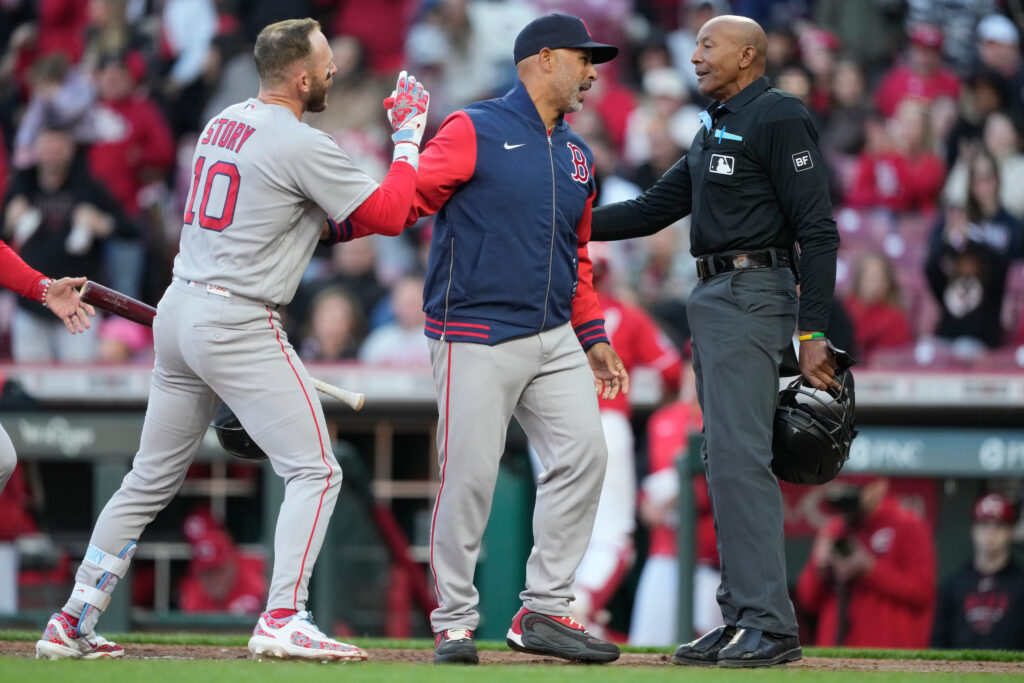
Now? A hitter taps his helmet, a challenge is issued, and ten seconds later the entire stadium sees exactly how far a pitch missed the plate. It’s a mini-audit in real time. We aren’t noticing more mistakes because umpires are getting worse; we’re noticing them because they’ve become a part of the broadcast’s choreography.
Why the Numbers Look “Ugly” Right Now
That jump to 4.4% isn’t an overnight collapse in talent. It’s a perfect storm of three things:
- Survivor Bias: The challenges highlight the most egregious misses. We’re essentially watching a “Greatest Hits” reel of every bad call, which makes the overall performance feel lower than it actually is.
- Small Sample Size: 90 games is a blink of an eye. A couple of outlier “disaster games” early on will skew things heavily.
- The “Exact” Zone: Umps are adjusting to a world where the zone is no longer a suggestion or a “range.” It’s a digital box, and being off by half an inch is now a public failure.
Where This Is Actually Headed
If you project that 4.4% out, you’d hit 100+ “bad” games this year. That sounds dramatic, but it’s unlikely to happen. ABS is less a scoreboard tool and more of a feedback loop to ensure the best product is being put out there.
Umpires now have an immediate “right answer” to every call they miss. That kind of accountability usually leads to a tightening of the screws. We’ll likely see a “noisy” first half of the season followed by a significant settling down as officials calibrate.
The Bottom Line
In 2025, we cared about accuracy. In 2026, we care about accountability.
The “bad” data we’re seeing isn’t a sign that the system is failing; it’s proof that the system is working. We can see everything now; every missed corner and every blown high strike. It’s going to feel messy for a while, but that’s just what happens when you turn the lights on in a room that’s been dark for a hundred years.
So Why Should I Care About ABS?
This shift in baseball mirrors a much larger “reckoning” across the sports marketing landscape. For years, teams and brands operated on “vanity metrics” and general vibes; much like an old-school umpire’s subjective strike zone. You’d buy a sponsorship, see a logo on a broadcast, and assume it was working.
But 2026 is the year of the Digital Audit. Just as ABS puts an umpire’s every move on the Jumbotron, modern tracking data and real-time triggers are putting every marketing dollar under a microscope. Fans are no longer just passive viewers; they are second-screen participants who expect brands to show up at the exact right moment…the buzzer-beater, the successful challenge, or the game-winning home run.
Moving forward, accuracy and accountability aren’t just technical requirements; they are the new baseline for trust. If a brand misses the “moment” because their data was lagging, or if an umpire misses a call that the entire stadium can see is wrong, the audience loses faith instantly. Whether it’s a 98-mph heater on the black or a high-stakes ad buy, the “black box” era is over. The lights are on, the cameras are rolling, and there is no longer any room to hide behind “close enough.”